Friday, October 11, 2019

Experiment 5 Heat Transfer

Experiment 5 Heat Transfer
Topic: Heat Transfer
Title: Thermal conductivity
Objective: To determine the thermal conductivity of glass
Theory:
The rate of heat flow through a conductor is expressed as 
<math xmlns="http://www.w3.org/1998/Math/MathML"><mfrac><mrow><mi>d</mi><mi>Q</mi></mrow><mrow><mi>d</mi><mi>t</mi></mrow></mfrac><mo>=</mo><mo>-</mo><mi>k</mi><mi>A</mi><mfrac><mrow><mi>d</mi><mi>&#x3B8;</mi></mrow><mrow><mi>d</mi><mi>t</mi></mrow></mfrac></math>        (1)

Where k is the thermal conductivity, A cross-sectional area of the conductor and <math xmlns="http://www.w3.org/1998/Math/MathML"><mfrac><mrow><mi>d</mi><mi>&#x3B8;</mi></mrow><mrow><mi>d</mi><mi>t</mi></mrow></mfrac></math> the temperature gradient.
Rate of heat flow from the warm water with temperature 0 in the boiling tube to the surrounding is given by
........ (2)
wherem is the mass of water, c the specific heat capacity of water anddtthe rate of cooling.
Equating (1) and (2)
mc dt= -kAdx ........ (3)
From equation (3), if the surrounding temperature is 0 °C the relationship between temperature θ and time t is given by
= -ktBrx+ 0 ,
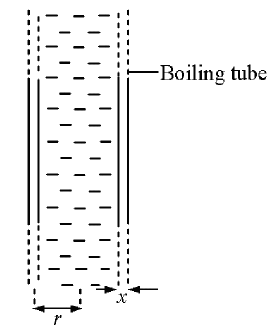
wheret is in second, 0 the initial temperature, B is 2.1 X 10⁶ J m-3K-1, r the average radius of the boiling tube, and x the thickness of the wall of the boiling tube.

Apparatus:
i. A boiling tube
ii. A thermometer (-10 °C - 110 °C)
iii. A 1000 cm3 beaker
iv. Two stirrers
v. A cork stopper
vi. A stopwatch
vii. A pair of vernier calipers
viii. A retort stand and clamp
ix. Ice cubes 
x. Warm water 

Procedure: 
(a)    Measure and record the internal and external diameters of a boiling tube and hence calculate the average radius r and the thickness x of the wall of the boiling tube.
(b)    Fill up a beaker with water and ice. Clamp the boiling tube on to a retort stand and lower the boiling tube into the beaker until the whole of the boiling tube almost submerge in ice and water mixture as shown in the Figure 5.
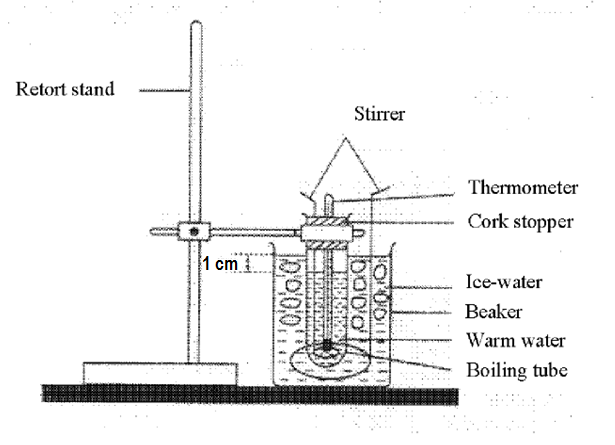
Figure 5
(c)    Pour warm water into the boiling tube until the water level inside the tube reaches about 1 cm below the ice-water level in the beaker. The temperature of the ice and water mixture inside the beaker should be 0 °C before the warm water is poured into the boiling tube.
(d)    Insert the stirrer and thermometer through the cork stopper as shown in Figure 5.
(e)    Record time t and the corresponding temperature θ starting at temperature around θ = 30 °C. Record time t and temperature  until the temperature in the boiling tube reaches about 5 °C. The ice-water mixture in the beaker and warm water in the boiling tube should be constantly stirred throughout the experiment.
(f}    Plot a graph of In θ against t.
(g)    Determine the thermal conductivity of the glass. or alternative
Using interface PC thermometer , from "PCsensor" TEMPer1F


alternatif penggunaan jangka suhu


Data :

Graph :


Experiment 4 Static

Experiment 4 Static
Topic: Statics
Title: Density of an object 
Objectives: To determine the density of an object using a spring system.
Theory:
Figure 2. h must be constant

Figure E7- 2
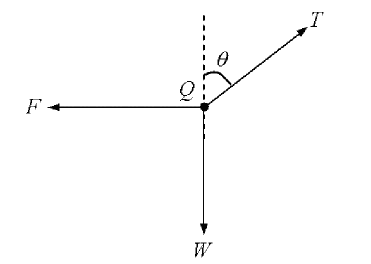
Figure 2 shows forces acting at point Q where T the tension in the thread is,F 
is the tension in the spring and W is the weight of object A.
The equation below show the condition for equilibrium at point Q
Tsin =F,
T cos =W,
Hence,
w=F tan ……………(1)
From Figure 1,we have
tan =xh
For the spring,
F=k(l-l0),
Where kare the spring constant and l0 the unstretched length.
From equation (1),
W=k(l-l0)xh,
l=wkhx+l0 .
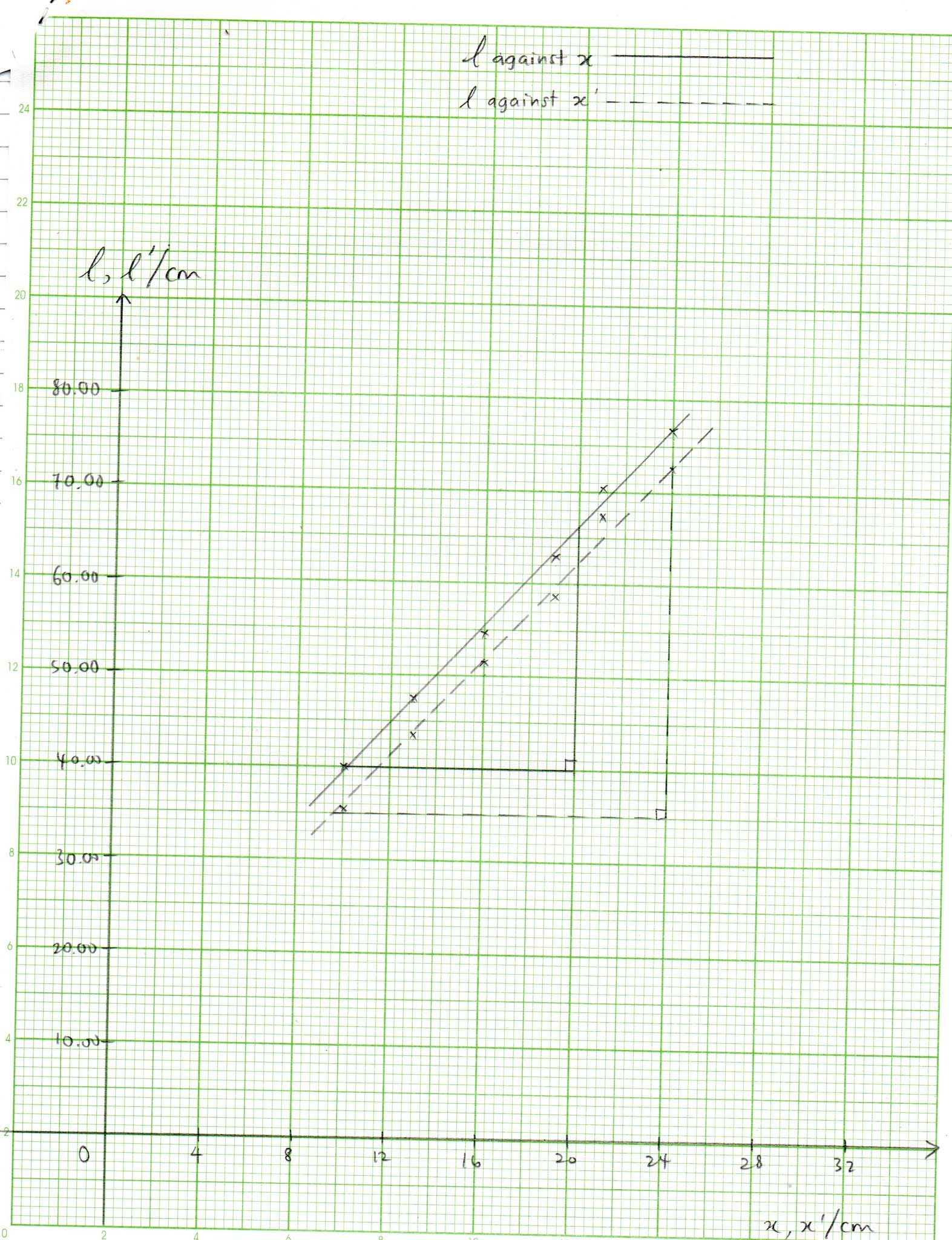
For constanth, the gradient s of graph l against x is proportional to  W .
The weight of object A,
W=VAg……..(2)
Where V are the volume and A the density of object A.
When object A is immersed in water, the up thrust acting on the object is given by 
Up thrust=W-W'=VWg………(3)
Where W' is the apparent weight of object A and Wthe  density of water.
Dividing equation (2) by equation (3),
(3)(2)WW-W'=AW,
A=ss-s'w……….(4)
Where s' is the gradient of graph l'against x'

Apparatus:
i. A spring
ii. Thread
iii. A pendulum bob
iv. An object A
v. A half-metre ruler
vi. Two retort stands with clamps
vii. Weights to stabilise stands
viii. A 500 cm3 beaker 

Procedure:

(a) Set-up the apparatus as shown in Figure 3. (Note: make sure that the spring is 
stretched such that it is just enough to be in horizontal position).
(b) Make a reference mark P on the thread which hangs the pendulum bob. This mark 
should be higher than the level where object  A is tied to the spring.
(c) Move the retort stand on the left to increase the angle B and adjust the loop until the 
spring is horizontal.
(d) Measure and record the corresponding length of the spring  L and horizontal distance 
from P to the thread x.
(e) Repeat step (c) for different values of L and x.
(f) Plot a graph of L against x.
(g) Repeat step (c) to (e) with object A immersed in a beaker of water.
(h) Measure and record the corresponding L’ and x', using the same range of x in step (e).
(i) On the same axes as in step (f), plot a graph of L’ against x'.
(i) Determine the gradients s and s'.
(k) Determine the density of the object A.

Data:


Graph: